Monday, April 03, 2017


For inspiration this past winter, I wrote an illustrated book of tributes to 21 gifted people who made my life significantly more interesting than it would have been otherwise. For my Vector portrait of each, I used a photo source of my subject’s micro expression, a fleeting facial expression that revealed an emotion behind his or her drive.

The spaces where my subjects worked I think are particularly interesting because they show how someone excited about bringing ideas to life can design and create their “dream space” that gives you the freedom and the time: a room in your house, an office; computer; your car.

No matter how varied my subjects’ workspaces, all settings provided the opportunity to collaborate, long stretches of time necessary for concentration, and a cultural requirement to think of how much an invention or innovation would help others.

Some workspaces were built-in, established by corporate, military, academic entities that needed solutions to problems as soon as humanly possible. Company leaders assigned their scientists problems to solve, or the scientists on their own identified problems and brought their solutions into being.

AT&T’s Bell Labs gave us the replacement for the vacuum tube, the transistor, as well as the digital camera sensor; General Electric’s laboratory, the LED bulb; Texas Instruments’ lab, the microchip; RCA’s lab, the liquid crystal display; and Intel’s lab, the microprocessor.

The U.S. Military, a famously prolific source of invention, gave life to COBOL, the first computer program to write in English, and the Global Positioning Satellite navigation system.

Out of a university basement physics laboratory came the first electronic digital computer. At another university, two Ph.D. candidates produced a site where information is readily available by tapping a few strokes on a keyboard. At a third, a group of roommates in a university dorm, led by a young visionary, created a social media site that is now uniting all citizens of the world in friendship.

Individual inventors and innovators dedicated spaces in their homes as shops or as labs. An actress and self-taught engineer, who invented a jam proof guidance system for torpedoes, set aside a large room in her home. Macintosh Computer was born in a garage.
Working in and from their offices, other individual inventors and innovators set out to solve problems that nagged at them. Because of a media arts instructor’s concern about the hurry with which material had to be delivered in a typical classroom, we can now learn in depth any aspect of the field from her video tutorial online site. A businessman, dismayed by the number of customers who bought electronic devises they couldn’t learn to use, established a tutoring service through which you can hire an instructor to come to your home and make it possible for you and your device to work amicably together.

I’m hoping my subjects will inspire us all to more fully engage our imaginations to solve problems, starting with a space dedicated to our new focus. We can identify a nagging problem, list ways to solve it, choose the best among the proposed solutions, and then try each one. Who else among friends and associates would be interested? Invite them to join you. Brainstorm.

Persist. The man who created Blogger stuck with it even after his partner deserted. Alone, he posted bloggers’ entries until Google bought his company.

Facebook founder Mark Zuckerberg’s advice: “If you just work on stuff that you like and are passionate about, you don’t have to have a master plan with how things will play out.”


Tuesday, October 18, 2016


Recently I participated in a Miksang workshop, “Opening the Good Eye”, headed by gifted photographer April Siegfried. We practiced a style of meditation designed specifically for photographers: the Miksang system of contemplative photography.

The only way I can describe the method is with a few brush stokes whereby I might convey what it is like. You give your mind’s eye the entire stage. Sit alone somewhere. Close your eyes. Wait for mental clutter to recede. It helps me to concentrate on my breathing.
You gain the sense that this is the only place you want to be.

When there’s a pause free of mental chatter, turn your head to face another direction, and open your eyes. Colors and edges take on presences of their own. Gradually your eyes find a subject that may be nothing in and of itself but, in terms of color, texture, line, or lighting, it reaches out, as if asking to be photographed.

For the “yellow” exercise, I photographed this fire hydrant featuring a chain. I’d never looked at a fire hydrant quite that way before.

For more information about Miksang: http://www.miksang.com

Monday, October 03, 2016


Against the stable foreground trees, the expressway below seems to veer off and up to the right hand side of the image, as if trying for an escape. This composition would not have reached out to me without my sitting in the same spot, basking in the mountain air and letting the place “talk” to me for a while. From Point Park, Lookout Mountain, Tennessee.

Sunday, September 04, 2016

When taking photographs I try to settle into a meditative mode, concentrating on my breathing. Mental chatter and ruminative daydreaming remain but recede in importance. Michael Wood, in his book “Opening the Good Eye”, emphasizes the importance of staying in the same place for hours to give elements in that environment enough time to reach out to you.

As if on cue, after I finished Wood’s book, my car had to be serviced. I was stuck for hours waiting for the job to be done. Boredom, impatience, noise, and hustle made the meditative mode difficult to achieve, but I forced myself, until that car dealership became the only place I wanted to be in the entire world.

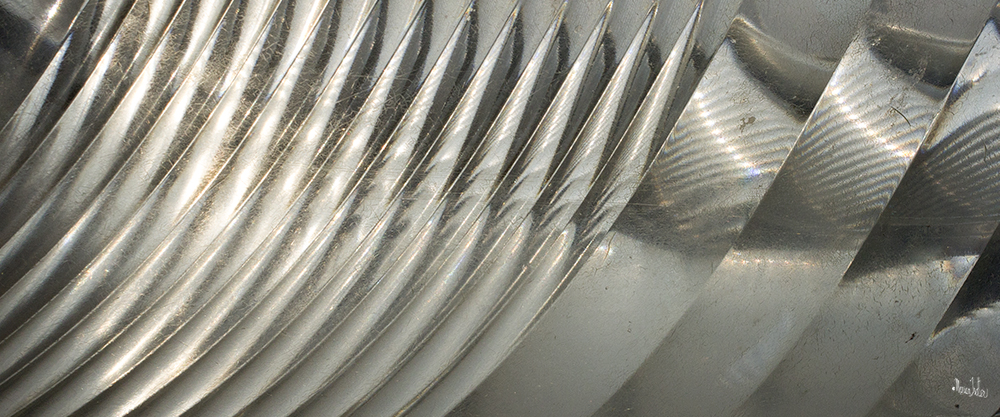
After a long while, headlights, taillights, chrome, and shiny painted areas started to reach out to me for attention. Here are my favorites:

1- Blinding reflections of the sun bounce back and forth against a complex array of surfaces inside a headlight. Scrapes and scratches from wear and tear add texture.


2 - A car door reflects a window. It gives me the urge to convert it into an oversized oil painting.


3 - A closeup of a headlight is recognizable as such. I love the wide range between sharp focus and blur created by narrow depth of field.


Saturday, June 04, 2016


As a photographic artist, I run aground every now and then. Sometimes I think I might start repeating myself, I’ve come to the end of a series, or I’ve just run out of ideas. A recent experiment to dislodge myself from “photographer’s block” is a flop.

On Facebook, I’m following the Miksang Institute for Contemplative Photography.

http://www.miksang.com

Their images are surreal and exquisitely simple at the same time. I want to be close to their subject matter and sit with it for a while. The message: Empty yourself of all preconceived visual frameworks, be still, and let what you see become a part of you.


After immersing myself in these images, I was hurrying off to do routine errands, when this seemed to hit me in the face. Against the interior garage wall, the sun cast reflections and shadows of a break light on my car.